
Which Statement Best Describes a Mole? – Understanding the Basics and Applications
In scientific terms, the word “mole” carries specific significance, especially in chemistry. It refers to a measurement unit that helps scientists and students quantify large quantities of atoms, molecules, and other particles. But which statement best describes a mole? This article dives into the core understanding of the mole concept, its historical roots, its importance in scientific calculations, and practical applications.
Understanding the Definition of a Mole
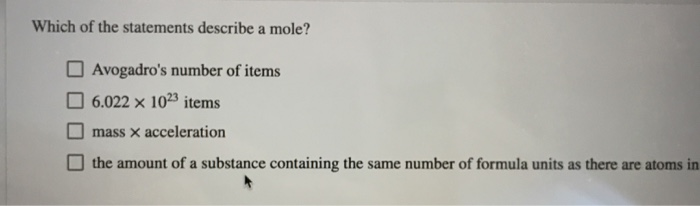
The mole is fundamentally a unit used to measure substance quantity in chemistry. A mole represents a quantity (Avogadro’s number) equal to 6.022×10236.022 \times 10^{23} particles (atoms, molecules, ions, or electrons), a number chosen for its utility in measuring atomic and molecular masses at a macroscopic level.
Origins of the Mole Concept
The concept of a mole traces back to early 19th-century chemistry when scientists sought ways to quantify matter on a molecular level. Italian scientist Amedeo Avogadro proposed the hypothesis that, under the same temperature and pressure, equal volumes of gases contain the same number of molecules. This hypothesis led to the mole concept being an effective unit for measuring large numbers of tiny particles.
Why is the Mole Important in Chemistry?
The mole simplifies complex calculations involving chemical reactions and compounds. Instead of dealing with atoms and molecules individually, scientists can use moles to predict the proportions of reactants and products in reactions, making it easier to calculate quantities for practical applications like chemical manufacturing, medicine, and environmental science.
Avogadro’s Number and Its Importance
Avogadro’s Number (approximately 6.022×10236.022 \times 10^{23}) defines how many particles are in one mole of a substance. This allows chemists to measure amounts in the laboratory conveniently, bridging the gap between the microscopic world of atoms and the macroscopic quantities used in real-world applications.
How to Describe a Mole Accurately
In answering which statement best describes a mole? consider these core points:
- A mole represents a specific quantity of particles: Whether you’re measuring atoms, molecules, or ions, one mole is 6.022×10236.022 \times 10^{23} of those entities.
- The mole is a SI base unit: In the International System of Units (SI), the mole is the standard unit for measuring the amount of substance.
- It’s essential for stoichiometry: In chemical reactions, the mole provides the basis for determining reactant and product quantities, ensuring that reactions are balanced and predictable.
Practical Applications of the Mole in Everyday Science
The concept of the mole extends beyond chemistry and into everyday applications. Here are some areas where the mole plays a crucial role:
Medicine and Pharmaceuticals
In pharmaceuticals, dosages for drugs are often calculated based on molar quantities. Understanding the mole ensures accurate calculations for the ingredients needed in drugs, vaccines, and treatments.
Environmental Science
In environmental studies, the mole helps scientists calculate pollution levels and analyze substances like greenhouse gases in the atmosphere. This enables scientists to monitor environmental changes and make data-driven decisions about environmental policies.
Food Science
The mole is useful for food scientists who need to know the specific composition of food additives, nutrients, or preservatives. Knowing the exact molecular composition helps ensure that food products are safe and meet regulatory standards.
How to Use the Mole in Calculations
For students and scientists alike, mastering the mole is crucial for various calculations. Here’s a breakdown of common calculations involving the mole:
Molar Mass Calculations
Molar mass is the mass of one mole of a substance, expressed in grams per mole (g/mol). For instance, the molar mass of water (H₂O) is about 18 g/mol. This value comes from the atomic masses of hydrogen and oxygen on the periodic table.
Converting Moles to Particles and Vice Versa
To convert moles to particles, multiply the amount of moles by Avogadro’s number. Conversely, to find the number of moles from a given quantity of particles, divide by Avogadro’s number. This calculation allows chemists to switch between particle count and molar quantity seamlessly.
Stoichiometry and Balanced Equations
The mole is also essential for stoichiometry—the quantitative relationship between reactants and products in a chemical reaction. Balancing equations requires understanding the mole ratios of each substance involved. For example, in the reaction 2H2+O2→2H2O2H₂ + O₂ → 2H₂O, the ratio of hydrogen to oxygen to water is 2:1:2.
Common Misunderstandings About the Mole Concept
Understanding which statement best describes a mole helps clarify common misunderstandings:
- A mole does not refer to mass: Although related to molar mass, the mole itself only quantifies particle count.
- The mole is not unique to any specific type of particle: Moles can quantify any type of particle, whether atoms, molecules, or ions.
- The mole is distinct from Avogadro’s number: Avogadro’s number quantifies the number of entities in a mole, but the mole is a unit that defines quantity.
The Mole in Modern Chemistry – Key Developments
The mole remains a vital unit in modern chemistry, with advances making calculations more accurate and meaningful.
Redefining the Mole in SI Units
In 2019, the International System of Units (SI) redefined the mole to be more precise. It is now defined by fixing Avogadro’s number at exactly 6.02214076×10236.02214076 \times 10^{23}, which ensures consistency and accuracy across scientific disciplines.
Digital Tools and Mole Calculations
Today’s chemists use digital tools and software to perform mole-based calculations quickly. From balancing equations to conducting experiments, software simplifies the use of the mole in chemistry labs and classrooms, making it more accessible for students and professionals alike.
Frequently Asked Questions (FAQs)
Q1: Which statement best describes a mole in simple terms?
A mole is a unit that represents a large quantity of particles, precisely 6.022×10236.022 \times 10^{23} particles, often used to count atoms, molecules, or ions in a substance.
Q2: Why is Avogadro’s number associated with the mole?
Avogadro’s number, 6.022×10236.022 \times 10^{23}, represents the number of particles in one mole of any substance, making it easier to work with chemical quantities on a macroscopic scale.
Q3: What are the practical applications of the mole?
The mole is used in fields like chemistry, medicine, environmental science, and food science to quantify substances and conduct precise calculations essential for experiments and product formulations.
Q4: How is a mole different from molar mass?
A mole is a quantity of particles, while molar mass is the mass of one mole of a substance, typically measured in grams per mole (g/mol).
Q5: Can the concept of a mole apply to non-chemical entities?
Yes, theoretically, the mole can quantify any type of particle or entity, though it is primarily used in chemistry.
Q6: Which statement best describes a mole in relation to chemical reactions?
In chemical reactions, the mole provides a way to balance equations by ensuring that the quantities of reactants and products follow stoichiometric ratios based on mole relationships.
Conclusion
The mole is more than just a unit of measure; it’s a gateway to understanding the chemical world. From balancing equations to analyzing environmental data, the mole provides a practical way to work with the vast numbers of tiny particles involved in chemical substances. By understanding which statement best describes a mole, students, scientists, and professionals can better appreciate its importance and utility in various scientific applications.