Wordle Hints: Clues for Puzzle 1955 (Oct 26)
Monday, October 26, 2026 brings Wordle puzzle number 1955, a puzzle that looks friendly at first glance and then refuses to resolve. This guide to wordle hints is built the other way around from a simple answer page. It gives help in small, controlled steps, so you can stop the moment the word clicks and still feel that you solved it yourself. You will not find the solution at the top. Instead, you will find a progressive ladder that moves from shape to sound, then to meaning, and only at the very end, in a clearly labelled spoiler section, to the answer itself.
The approach matters because Wordle is a game of elimination as much as inspiration. With only six guesses, every guess should either test new letters or confirm a pattern you already suspect. Read one rung, return to the game, and make a guess before reading the next one.
If you enjoy daily word games and want more puzzles and guides in the same style, the Wordiply homepage is the place to start. Everything here follows the same spoiler-safe structure, so you can use it mid-game without worrying that the answer will jump out before you are ready.
How to Use This Guide Without Spoiling the Solve
The most useful habit in this guide to wordle hints is also the simplest: take only as much help as you need. Start by making at least one honest guess on your own, even if it is just your usual starter word. That first guess gives you green, yellow, and gray tiles to work with, and the hints below become far more powerful when they combine with real feedback from your own board.
Work through the ladder in order, and treat each rung as a stopping point rather than a step you must pass through. Many players will solve the puzzle after the first or second rung, and that is a success, not a shortcut. Others will need the meaning clue, and a few will want the full pattern before a final guess. All of those paths are valid.
- Play your normal starter word and note every green, yellow, and gray tile.
- Read the first rung only, then return to the game for your next guess.
- If you are still stuck, read the next rung and reshape your candidate list.
- Before your fifth or sixth guess, run the checklist near the end of this guide.
- Open the spoiler section only when you would rather know than keep guessing.
The Hint Ladder at a Glance
Here is the whole ladder in one place. Use this table as a map. If you only want a gentle nudge, stop after the first two rows. If you want a serious push, keep going to the pattern row. The meaning row is the last hint before the spoiler section, and it is designed to be the moment when many readers will suddenly see the word.
| Hint level | What it reveals | What it still hides |
|---|---|---|
| Hint One: Shape | Five letters, with a familiar frame | The middle letters and the meaning |
| Hint Two: Vowels | One vowel type, used twice | Where the vowel sits |
| Hint Three: Pattern | The first letters and the repeated vowel | The fourth letter |
| Hint Four: Meaning | The word class and a definition | The exact spelling |
| Spoiler section | The full answer, clearly labelled | Nothing |
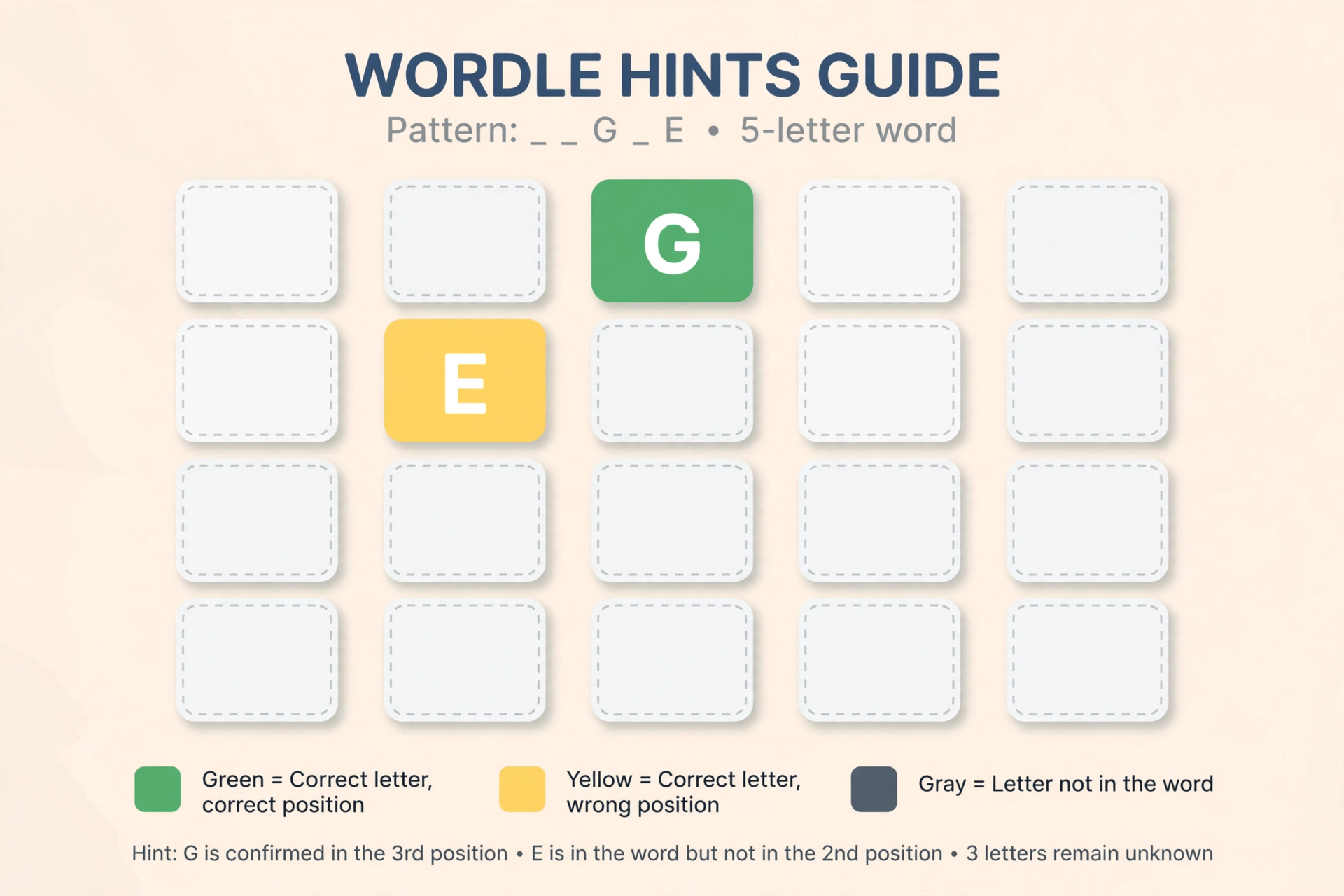
Notice that the ladder never asks you to guess blindly. Each rung is written so that you can return to the game immediately and use it. The game itself is simple: you have six guesses to find a five-letter word. Green means the letter is correct and in the correct position, yellow means the letter is in the word but in the wrong position, and gray means the letter is not in the word. A new puzzle arrives at midnight in your local time, and the New York Times editor for Wordle is Tracy Bennett.
Hint One: The Shape of Today’s Word
Here is your first gentle nudge. Today’s answer has five letters, and it follows a frame many players will recognize once they see it: it starts with G and ends with Y. That gives you the skeleton G _ _ _ Y. On its own, that frame still leaves many possibilities, but it kills off entire families of guesses at once. Any word that does not start with G or does not end with Y cannot be the answer, no matter how good it looked as a second guess.
The G opening deserves attention, because G is not one of the most common opening letters in starter-word strategy. Most popular starters begin with S, C, T, or A, so a G start can feel unfamiliar even when the word itself is common. If your starter was SLATE or CRANE, you will have learned nothing about G yet, and your second guess should deliberately test G in first position rather than hoping it appears somewhere else.
Hint Two: The Vowel Clue and the Repeated Letter
Ready for a stronger hint? Today’s word contains only one type of vowel, and that vowel appears twice. That fact transforms the puzzle. Vowel-heavy guesses that test A, I, O, and U alongside E are now wasted effort, because only one vowel family is present. If your first guess lit up several different vowels, recheck the board before you go further.
The repeated vowel is E, and it sits in the middle of the word rather than at the end. Many players expect E to appear at the end of a five-letter word, because so many common words place E last. Today’s word breaks that habit. If you keep trying E-ending words after this hint, you are fighting the clue instead of using it. Shift your thinking toward words where E appears twice in the centre, and your candidate list will shrink dramatically.
- One vowel type only, used twice, so extra vowel tests waste guesses.
- The vowel is E, not A, I, O, or U, so rule out candidates containing those letters.
- The repeated E is central, not final, so E-ending guesses do not fit.
- A doubled letter in the middle should be tested before you run out of guesses.
Hint Three: The Letter Pattern, Step by Step
This is the biggest structural reveal before the spoiler section, so read it only when you are ready for a tight pattern. Combining the frame and the vowel clue gives you G E E _ Y. The first letter is G, the second and third letters are both E, and the last letter is Y. Only the fourth letter remains unknown, and it is a consonant.
Work inside the pattern rather than around it. Say the skeleton aloud, G, E, E, blank, Y, and listen for words that fit that rhythm. The double E creates a long vowel sound in the middle, and the final Y softens the ending into an adjective-like quality. Words that break the pattern, even by one position, should be discarded immediately, however attractive they seem. A guess that fits four out of five confirmed positions is not almost right in Wordle. It is wrong, and in the late game it can cost a streak.
Hint Four: The Meaning Clue
If the pattern has not yet produced the word, let meaning do the final work. Today’s answer is an adjective meaning resembling or characteristic of a geek, in the sense of someone who is deeply enthusiastic about a niche or technical subject. It describes a quality, a style, or a way of being enthusiastic, rather than naming an object or an action.
Now combine meaning with pattern. You need an adjective, starting with G, with a double E in positions two and three, a single consonant in position four, and a Y at the end, meaning resembling a geek. A word that fits the pattern but means something unrelated is not the answer. A word that fits the meaning but breaks the pattern is not the answer either. When a single word passes both tests, you have almost certainly solved puzzle 1955.
Starter Word Analysis for Today
A thoughtful starter-word discussion is at the heart of good wordle hints, because the first guess determines how much information you buy with a single turn. Today’s puzzle is unusually revealing: three of the most popular starters all return the same limited feedback, and understanding why will improve your second guess far more than switching to a fashionable new starter.
| Starter word | Why players choose it | Feedback against today’s word |
|---|---|---|
| SLATE | Tests common consonants plus A and E | Only E is present, as yellow, not in fifth position |
| CRANE | Tests C, R, A, N, and a final E | Only E is present, again as yellow |
| ADIEU | Tests four vowels at once | Only E is present, again as yellow |
The lesson is not that these starters are bad. In general play, SLATE and CRANE are excellent because they test high-frequency letters, and ADIEU is useful when you want to settle the vowel question quickly. The lesson is that a starter ending in E can mislead you on a day when E sits in the middle and appears twice. A yellow E tells you E is in the word, but not how many times it appears, and not that the final position is Y.
How Today’s Grid Usually Unfolds
Most successful solves follow a recognizable rhythm, and describing it in advance can help you recognize where you are in your own game. In this guide to wordle hints, the typical path is not a single brilliant guess but a sequence of information-buying moves that gradually close off wrong families of words. The first guess tests breadth, the second tests position, and the third tests structure, including a repeated letter.
- Guess one: play a familiar starter such as SLATE or CRANE and record the tiles.
- Guess two: move yellow letters to new positions and test G in first position.
- Guess three: deliberately test a repeated letter, especially a double E in the middle.
- Guess four: lock the frame G E E _ Y into place and brainstorm only fitting words.
- Guess five: use the meaning clue to choose between surviving candidates.
- Guess six: submit only a word that fits the pattern, the meaning, and every tile.
Notice how late meaning enters this sequence. That ordering is deliberate. Meaning is powerful, but it is easy to misapply when the pattern is still wide. A player who starts from meaning alone might think of dozens of adjectives for enthusiasm, most of which do not fit the letter frame. Let pattern narrow the field first, so that when meaning arrives, it has only a few candidates to choose between.
Handling Double Letters Without Wasting Guesses
Double letters deserve a section of their own, because they are the single most misunderstood mechanic in the game. In this guide to wordle hints, the double-letter lesson from today is simple: a repeated letter is not a rare exception to plan for at the end, but a normal possibility to test in the middle of the game. Today’s answer repeats E, a vowel, which makes the trap subtler than a doubled consonant. A doubled vowel can hide inside a word that otherwise looks like it has five different letters.
How do you know when to test a double? There are three reliable signals. First, you have used two or three guesses with all-different letters and none has produced more than one green tile. Second, you have a yellow letter that refuses to find a green home. Third, you have a strong frame, but no all-different word fits it comfortably. Any one of those signals is a reason to spend a guess on a double. Waiting until guess five or six is the mistake, because by then you may have no room to recover.
- Test a double by guess three if all-different guesses have stalled.
- Place both copies in the positions you suspect, rather than floating one elsewhere.
- Remember that a gray second copy does not mean the letter is absent.
- After a double test, rewrite your candidate list around the new count.
Hard Mode and WordleBot Style Self Review
Hard Mode changes the game in one important way: any green or yellow letter revealed in a previous guess must be used in all subsequent guesses. That rule sounds restrictive, but it also forces the discipline that good players use voluntarily. In Hard Mode, you cannot spend a guess testing a completely new set of letters while ignoring a yellow E. You must carry that E forward, which forces you to think about where E belongs rather than postponing the question.
There is a related skill that strong players practice after the game ends, often called a WordleBot-style self-review. WordleBot is the New York Times analysis tool that reviews your guesses and suggests a more efficient path. You can do a simpler version yourself in under a minute. After you finish, ask three questions: did each guess test new information, did it respect every green and yellow tile, and did it consider a repeated letter early enough? Over a week, that review will reveal a pattern, perhaps you repeat gray letters, avoid doubles, or guess from meaning before the pattern is narrow.
Protecting Your Streak on a Tricky Day
Streak protection is less about any single puzzle and more about how you behave when a puzzle starts to feel dangerous. In this guide to wordle hints, the streak advice for today begins with a simple rule: slow down when you reach guess four. Many streaks end not because the word was impossible, but because a player who had guesses left rushed through them, repeating a gray letter on guess five and guessing a pattern-breaking word on guess six.
A second streak rule is to keep a fallback candidate ready. Before you submit guess five, identify not just your favourite candidate but also a second word that fits the pattern, in case the favourite is wrong. If you cannot name a second fitting word, that is valuable information: it may mean your favourite is the only real candidate, or it may mean your pattern reading is wrong and you need to recheck a tile. Either way, the exercise forces you to test your assumptions before you spend a guess.
- Pause for twenty seconds before guesses five and six.
- Name a backup candidate before you submit guess five.
- Check every guess against your gray-letter list.
- Never submit a word that breaks a green or yellow tile.
- Take a short break if frustration is narrowing your thinking.
Common Ending Traps With Y and KY Words
Words ending in Y form one of the largest and most tempting families in Wordle, and that size is itself a trap. When a player confirms a final Y, the mind jumps to familiar adjectives such as HAPPY, SUNNY, FUNNY, or LUCKY, and then struggles to move beyond that first set. Today’s answer belongs to a narrower family, words ending in KY, where the K before the Y creates a sharper, more clipped ending sound. Thinking in terms of the two-letter ending, rather than the single final letter, is the key to narrowing this family.
The KY family is larger than it first appears, and listing its members is a useful exercise. In this guide to wordle hints, the point of that exercise is not to memorize a list, but to learn how many plausible words share the same ending, which is why the rest of the pattern matters so much. Words such as PERKY, JERKY, MURKY, DORKY, and PORKY all end in KY, and several describe character or atmosphere in ways that could feel plausible. Without the G start and the double E, any of them might seem like a candidate. With those constraints, most fall away immediately.
Recent Answers and What They Reveal
Looking back at recent answers is not just trivia. It shows how often the game has used repeated letters, Y endings, and everyday vocabulary in the past week, and that context helps you judge whether today’s structure is unusual or part of a pattern. The table below lists the six puzzles immediately before today. None of these answers is today’s answer, and none should be guessed today unless it also fits today’s confirmed pattern, which these words do not.
| Date | Puzzle number | Answer | Pattern note |
|---|---|---|---|
| October 25, 2026 | #1954 | DRESS | Double S at the end; single E |
| October 24, 2026 | #1953 | HOLEY | Ends in Y; vowels O and E |
| October 23, 2026 | #1952 | TRILL | Double L at the end; single I |
| October 22, 2026 | #1951 | RESET | Double E, separated, not adjacent |
| October 21, 2026 | #1950 | PENNY | Double N in the middle; ends in Y |
| October 20, 2026 | #1949 | WREST | No repeated letters; single E |
Two patterns stand out from this short archive. First, repeated letters have appeared in four of the six recent puzzles, counting DRESS, TRILL, RESET, and PENNY, which means a player who never tests doubles is at a disadvantage in the current run. Second, Y endings have appeared twice, in HOLEY and PENNY, so a final Y should not surprise you. Today’s puzzle combines both tendencies, a double letter and a Y ending, which explains why it feels familiar and tricky at the same time.
Spoiler Section: Today’s Answer Revealed
Stop scrolling here if you still want to solve puzzle 1955 yourself. Everything above this section was written as hints, and everything below it ends the mystery. If you came looking for wordle hints and you have decided that you would rather know the answer than keep guessing, this is your final warning before the solution appears in plain text.
The answer to Wordle #1955 for Monday, October 26, 2026 is GEEKY.
GEEKY is an adjective meaning resembling or characteristic of a geek, someone deeply enthusiastic about a niche or technical subject. Letter by letter, it matches every rung of the ladder: G opens the word, E appears twice in positions two and three, K fills position four, and Y closes the word in position five. Some sources rate this puzzle as hard because of that combination, a double E in the middle and a KY ending, both of which break the habits of guessing five different letters and expecting E at the end.
FAQs
What is the Wordle answer for today, October 26, 2026?
The answer to Wordle #1955 on Monday, October 26, 2026 is GEEKY. It starts with G, ends with Y, contains E twice in positions two and three, and has K in position four. It is an adjective meaning resembling or characteristic of a geek.
What letters does today’s Wordle start and end with?
Today’s word starts with G and ends with Y, giving the frame G _ _ _ Y. Once the double E is added, the full pattern becomes G E E _ Y, leaving only the fourth letter, K, to complete the word.
Does today’s Wordle have a repeated letter?
Yes. Today’s word repeats the letter E twice, in positions two and three. That doubled vowel is the main reason the puzzle feels harder than its everyday vocabulary suggests, because many players instinctively guess words with five different letters.
What does GEEKY mean?
GEEKY is an adjective meaning resembling or characteristic of a geek, someone deeply enthusiastic about a niche or technical subject. It can describe a person, a style, a joke, a collection, or an interest that shows detailed, specialist enthusiasm.
When does the next Wordle puzzle come out?
A new Wordle puzzle goes live at midnight in your local time, so puzzle #1956 arrives on Tuesday, October 27, 2026. The game gives you six guesses, with green for a correct letter in the correct position, yellow for a correct letter in the wrong position, and gray for a letter that is not in the word.
What is the best starter word strategy for a puzzle like today?
Start with a familiar word such as SLATE or CRANE to test common letters, then adapt quickly to the feedback. On a day when the only feedback is a yellow E, move E inward, test G in first position, avoid new vowels you do not need, and test a double letter by your third guess.
Conclusion
Puzzle 1955 was a friendly word in a tricky shape, and that combination is why a careful approach to wordle hints matters more than a lucky first guess. The G start and Y ending gave you a frame, the double E gave you the middle, the KY ending narrowed the family, and the meaning clue, resembling a geek, turned a pattern into a word. Players who worked that ladder in order, and who tested a double before they ran out of guesses, had a clear path to GEEKY.
Carry three habits forward from today. First, test a repeated letter by guess three whenever all-different guesses have stalled. Second, treat a yellow vowel as a question about position and count, not just presence, and move it rather than repeating the same placement. Third, run a twenty-second checklist before your final guesses, checking the frame, the gray list, and every confirmed tile at once.