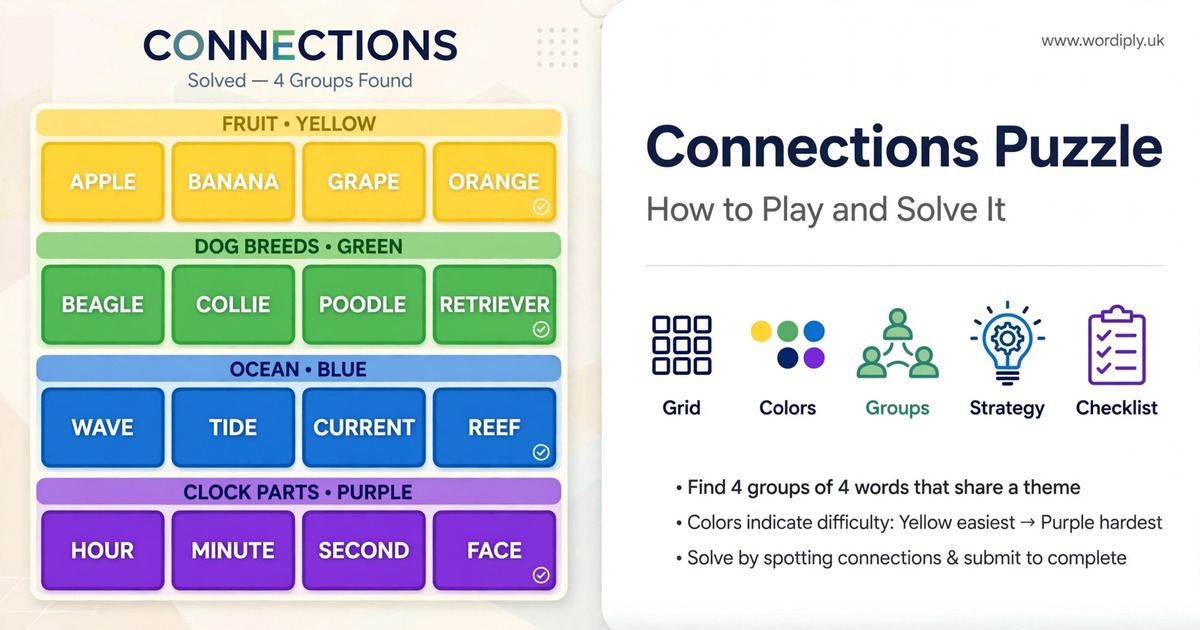
Connections Puzzle: How to Play and Solve It
A connections puzzle gives you sixteen ordinary words and one quiet challenge: find the hidden links that tie them together. Nothing explains those links in advance. You must read the words, test ideas, and decide which four belong together. That mix of language, logic, and patience is why so many players return every day.
Connections is published by The New York Times. A new puzzle appears at midnight Eastern Time, and everyone faces the same sixteen words that day. Sort the words into four groups of four, each sharing one connection. A correct group locks in place and reveals its color; a wrong group counts as a mistake, and four mistakes end the puzzle. For more word game guides, visit the Wordiply homepage.
How the Game Works
In a connections puzzle, you start with sixteen words in a grid. Select four you believe share a connection and submit them. If correct, the game removes them and shows the group name and color; if not, it records one mistake. Keep guessing until you find all four groups or use your four mistakes. The grid is designed to mislead: many words fit more than one group at first glance, as a noun in one reading and a verb in another, or as part of a phrase or name. Hold two or three meanings for a word at once instead of locking onto the first one.
The Four Color Levels
Each group has a color showing its intended difficulty. Yellow is easiest, green is next, blue is harder, and purple is hardest. Colors appear only when you solve a group. Yellow groups are usually direct: synonyms or a simple category. Green groups need one extra step, such as a narrower category. Blue groups often draw on general knowledge, names, or phrases. Purple groups rely on wordplay, not meaning: shared phrase partners, fill-in-the-blank patterns, or letter tricks. Since purple links are about form, not topic, they are often solved last.
| Color | Difficulty | What the Link Often Looks Like | How Players Usually Find It |
|---|---|---|---|
| Yellow | Easiest | Direct synonyms or a simple category | Found first, often quickly |
| Green | Next level | A clear category with one twist | Found after a second scan |
| Blue | Harder | Names, facts, or phrases | Found by testing knowledge and eliminating groups |
| Purple | Hardest | Wordplay or letter tricks | Often found last, by looking at word form |
Types of Groups You Will Meet
Most groups fall into four families. Meaning groups collect synonyms. Category groups collect examples of the same larger thing, such as parts of a whole. Phrase groups combine each word with the same other word to make familiar expressions, before or after each grid word; saying a candidate aloud with a possible partner often reveals one that silent reading misses. Wordplay groups play with spelling, sound, letters, or hidden words. When meaning and category fail, ask what the words look and sound like instead. Working through these families beats staring at the grid and hoping for inspiration.
| Group Family | Core Question to Ask | Common Sign | Typical Color Range |
|---|---|---|---|
| Meaning | Do these words mean a similar thing? | Synonyms or close shades of meaning | Yellow to green |
| Category | Are these examples of the same larger thing? | Parts, types, or members of one set | Yellow to blue |
| Phrase | Do these words all pair with one shared word? | Familiar expressions when combined | Blue to purple |
| Wordplay | Do these words share a letter, sound, or hidden pattern? | A pattern in form rather than topic | Mostly purple |
A Worked Example Dated October 27, 2026
This section looks at one real puzzle only as a dated worked example: NYT Connections number 1234, dated October 27, 2026. The groups below belong to that date and puzzle number only. They are not the answer for any other date and should not be treated as a timeless daily answer. Their value is in showing how the color levels and group families work together in one grid.
The yellow group was MESS (WITH): FIDDLE, MEDDLE, TINKER, and TRIFLE. This is a meaning group: each word can mean to mess with something or interfere. The link is direct once you read the words as verbs; reading them only as nouns may hide it. The green group was PARTS OF THE EAR: ANVIL, CANAL, DRUM, and STIRRUP. This is a category group. ANVIL and STIRRUP are small bones in the ear, DRUM refers to the eardrum, and CANAL refers to the ear canal. Thinking of an anvil only as a blacksmith tool, or a stirrup only as riding equipment, hides the link.
| Color | Group Name for October 27, 2026, Puzzle 1234 | Words | Group Family |
|---|---|---|---|
| Yellow | MESS (WITH) | FIDDLE, MEDDLE, TINKER, TRIFLE | Meaning |
| Green | PARTS OF THE EAR | ANVIL, CANAL, DRUM, STIRRUP | Category |
| Blue | ___ BELL | DIVING, JINGLE, LIBERTY, TACO | Phrase |
| Purple | BELL ___ | BOTTOMS, JAR, PEPPER, TOWER | Phrase |
The blue group was ___ BELL: DIVING, JINGLE, LIBERTY, and TACO. Each word pairs with BELL after it: diving bell, jingle bell, Liberty Bell, and Taco Bell. From sport and music to history and food, a topic search will not find them; only a phrase search will. The purple group was BELL ___: BOTTOMS, JAR, PEPPER, and TOWER. Each word pairs with BELL before it: bell bottoms, bell jar, bell pepper, and bell tower. This mirrors the blue group, with the shared word on the other side, so the player must split eight bell-related words into two sets of four by word order. Solving one makes the other much clearer. Together, the groups reward flexible reading. PC Guide reported a difficulty rating of 1.8 out of 5 for puzzle 1234, which reflects how that puzzle was rated, not a rule about how difficulty changes over time.
A Step-by-Step Solving Method
Follow the same calm order every day in a connections puzzle. It does not promise a win, but it protects your four mistakes. Move from obvious to strange, and from meaning to phrase to wordplay.
- Read all sixteen words slowly, out loud if you can, and note any immediate groups.
- Shuffle the grid and read the words again, watching for groups the first layout hid.
- Solve the group you trust most first, but check the remaining words could still form three sensible groups.
- Look for a second clear group, again checking the leftovers before you submit.
- When only eight words remain, test phrase partners, shared words before and after, and letter patterns.
- If a guess returns a one away message, change only one word at a time and test each swap.
- If you are down to your last mistake, stop and re-read the remaining words as verbs, nouns, names, and phrases.
The leftover check matters. A group may look correct alone but break the rest of the board: taking a word from a phrase group for a meaning group can leave the phrase group with only three words and no fourth candidate. A correct group should leave a board that still makes sense.
Strategies That Help on Hard Days
On hard days in a connections puzzle, expect several trap words, a wordplay purple group, and at least one group depending on a meaning you did not consider first. List candidate groups before submitting. A grid often contains five words that seem to fit one theme, when only four belong to it. Writing the five down makes the extra word visible, and it often belongs to another group. Also think in pairs first: find two words that clearly belong together, then hunt for a third and fourth sharing the same link. If no third word appears, the pair may be a trap or a phrase or wordplay link.
- Say each tricky word out loud in at least two meanings before settling on one reading.
- Test every candidate group against the leftovers, and reject groups that leave an impossible board.
- Use the shuffle button when the grid feels fixed, because a new layout breaks false neighbors.
- Save at least one mistake for the final groups, when a single wrong guess can end the game.
- When eight words remain, switch from topic thinking to phrase and letter thinking.
- After a one away message, change one word at a time instead of rebuilding the group.
Common Mistakes and How to Avoid Them
The most common mistake in a connections puzzle is submitting the first plausible group without checking the leftovers. It may be partly right, but if one word belongs elsewhere, the guess wastes a mistake and hides the real group. Always ask what the remaining words would become if your group were correct. Other frequent errors are reading a flexible word in only its most familiar meaning, forgetting phrase partners, ignoring letter patterns and sounds, and changing several words at once after a one away message. That message means three words are correct, so hold the likely trio steady and test single swaps.
- Submitting a group before checking whether the leftovers can still form groups.
- Reading a flexible word in only its most familiar meaning.
- Forgetting to test phrase partners, with a shared word before or after each grid word.
- Ignoring letter patterns, sounds, and hidden words inside longer words.
- Changing more than one word after a one away message.
- Using up mistakes early on groups that felt only half convincing.
A Checklist for Before You Guess
Use this checklist before every submission, especially with only one or two mistakes left. If you cannot tick most boxes, the guess is probably not ready yet.
- I have read all four words in at least two meanings or uses where possible.
- I have named the link in a short phrase, not just a vague feeling.
- I have checked that the remaining words could still form sensible groups.
- I have considered whether one word might belong to a phrase or wordplay group instead.
- I have used the shuffle button at least once when the grid felt stuck.
- I have saved a mistake for the harder groups, or I have a clear reason to use one now.
- After any one away message, I am changing only one word when retrying that group.
FAQs
How many mistakes can I make in Connections?
You can make a maximum of four mistakes. After the fourth wrong guess, the puzzle ends and the remaining groups are revealed.
What do the yellow, green, blue, and purple colors mean?
The colors show difficulty within a single puzzle: yellow is easiest, then green, blue, and purple hardest. They are revealed when each group is solved.
When does a new Connections puzzle appear?
A new puzzle is published by The New York Times at midnight Eastern Time. Each day brings sixteen fresh words, and one day’s groups do not carry over.
Why do some groups feel impossible until the end?
Those groups are often built on wordplay or phrase patterns rather than topic. When only a few words remain, the pattern becomes easier to see. Solve the clearer groups first, then switch to phrase and letter thinking.
Is it better to solve groups in color order?
No. Solve the group you can see most clearly first. Each solved group removes four words and makes the rest easier to spot.
What should I do when I get a one away message?
Treat it as a strong clue, not a failure. Three words are correct. Keep the most likely trio and change only one word at a time.
Conclusion
A connections puzzle rewards patience, flexible reading, and a willingness to change lenses. Read the words as meanings, categories, parts of phrases, and patterns of letters and sounds. Check your leftovers, protect your four mistakes, and use the shuffle button and the one away message as tools. Repeated daily, those habits make the grid feel less like a wall and more like clues waiting to be sorted.
The dated example from October 27, 2026, shows the method in action: a meaning group, a category group, and two mirrored phrase groups, each found by a different reading. Your next puzzle will use different words and links, but the same questions will help you find them. Name the link, test the leftovers, consider a second meaning, and give the hardest group time.